
Identity Verification for Global Enterprise
and Corporate Campuses

One Trusted Identity.
For Every Building.
Across Every Location.
Your enterprise no longer fits inside one building. Headquarters in one country, regional offices in another, R&D in a third, plus the contractors and vendors moving through all of them every week. Knowing who’s inside your facilities at any given moment gets harder to decipher.
That is the physical credentials like cards, keys, fobs and even PIN pads. They confirm a credential has been entered – they do not authenticate the identity of the person who used them.
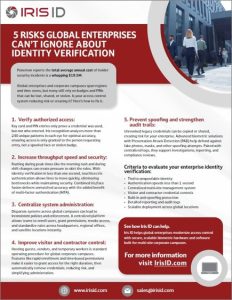
READ THE ARTICLE: Iris Recognition Delivers Superior Identity Authentication
Iris ID multi-factor iris and face recognition biometric readers provide the most accurate means to identify and authenticate every individual – at every door – in any location. This ensures that only authorized individuals gain access to permissioned areas at specific time periods – with authorization granted (or denied) in less than one second. All while providing a unified audit trail regardless if the entry point is located in Singapore or San Jose.
$19.5
MILLION – global average annual cost of insider risk in 2026
22%
Of breaches in 2025 began with stolen or misused credentials
83%
Of organizations experienced at least one insider attack last year
$373
MILLION – in U.S. payroll is lost annually to buddy punching
A unified access control solution with centralized management has become essential for any enterprise running distributed locations across multiple regions. Without it, standardizing protocols and producing clean audit trails takes far more effort than it should.
Where Enterprise Access Control Breaks Down
Identity Spread Across Buildings and Borders
A single employee in a global company often exists as multiple records across human resources, badge systems, time clocks, and visitor logs in different regions. Often these systems do not share data with each other. Onboarding a new hire across all locations can take weeks, while offboarding often misses one or more sites entirely, resulting in serious security vulnerabilities.
Lost, Shared, Stolen and Cloned Credentials
Physical credentials and PIN codes are regularly misplaced, and replacing them isn’t free. Fobs, card stock, printers, and helpdesk tickets all have related expenses. Less obvious is how badges are loaned between colleagues daily as a workplace courtesy. Older Wiegand readers add another challenge since they can easily be cloned with equipment costing less than $50 online.
Buddy Punching and Time Theft
When time and attendance run on PIN pads or swipe cards, employees can clock each other in. According to the American Payroll Association, buddy punching costs U.S. employers around $373 million each year in payroll. That figure excludes FLSA exposure, payroll dispute resolution, and audit costs that follow when timekeeping records do not match actual events.
Tailgating, Visitors, and Unverified Access
A typical corporate campus protects an executive floor, finance area, R&D lab, IT closet and server room with the same single-factor card swipe used at the lobby door. Yet the risk profile of those zones differs greatly from a reception area. Add the daily flow of meeting guests, repair crews, vendors, and unescorted contractors checked in by paper sign-in sheet. Tailgating into restricted zones often goes unnoticed even when surveillance cameras record it.
After-Hours Access and Cross-Border Data Headaches
Loading bays at 2 a.m., overnight lab work, and on-call engineers across time zones are routine in any global enterprise. So is the headache of biometric data residency. As more countries restrict cross-border transmission of biometric templates, a single global rollout becomes legally complicated for companies in regulated jurisdictions.

A Unified Identity Layer for Your Global Enterprise
Iris and Face Fusion Means Identity, Not a Card
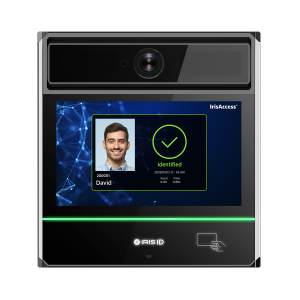
Iris recognition examines more than 240 unique patterns in each eye, with false acceptance rates near zero. On the IrisAccess® iA1000, this is combined with face recognition so every authentication ties to the actual person at the reader. There is nothing physical for an employee to lend or lose. Every iA1000 includes certified Presentation Attack Detection (PAD), which defends against spoofing attempts using printed photos, masks, contact lenses, or other counterfeit materials presented to the camera. Whoever the door verifies is always a live, present person.
READ THE ARTICLE: Security Biometric Authentication with PAD
One Browser. Every Site. Infinitely Scalable.
iAMS, our web-based IrisAccess Management Suite, gives administrators a single dashboard for the entire deployment. Iris ID solutions are infinitely scalable and work across states, oceans, continents, and beyond. Policies can be configured by role, department, door, or schedule. Granting access to a meeting room in Frankfurt from a laptop in New York takes seconds rather than tickets. REST APIs handle real-time data exchange with the security and HR platforms you’re already using and accustomed to.
Cross-Border Data Residency, Solved
When local laws prohibit transmission of biometric data across borders, Iris ID supports an alternative model where encrypted biometric data lives on a secure card carried by the employee. The card (and data) travels with the person, ensuring that biometric data is not transmitted illegally, and authentication anywhere in your corporate network remains seamless and hassle-free.
Lock Down Visitor and Contractor Access
Offering amenities for your employees requires third party vendors and contractors to support them. The iA1000 handles fast on-site enrollment for visitors and contractors, while iAMS lets you set credential expiration to match the visit duration, project timeline, or workday. Temporary access closes when time runs out, and every entry is logged for audit.
Compliant, Secure, and Ready for Integration
iAMS produces tamper-resistant logs ready for the audit cycles tied to ISO/IEC 27001, NIST, GDPR, and SOC 2. The iA1000 itself ships with AES-256 data encryption, network security hardening, secure boot, and tamper detection. The reader carries certifications that include FCC, CE, KC, UKCA, and UL294, and it supports both OSDP and Wiegand protocols. Practically, that means it integrates with the access panels, turnstiles, video management systems, and visitor platforms your security team already operates. There is no need to rip and replace infrastructure to get the level of biometric access control your enterprise deserves.
Why a Unified Identity Layer Matters
When iA1000 readers and iAMS operate as one connected system across your enterprise, security and operational benefits compound. A unified biometric access control platform supports:
– Accurate, trusted identity verification at every location
– Faster onboarding workflows and cleaner offboarding
– Real-time policy changes pushed across regions in seconds
– Audit-ready trails for ISO/IEC 27001, NIST, GDPR, and SOC 2
– Cross-border deployments that respect local data residency laws
– Throughput of less than 1 second per authentication at busy entrances
– Lower total cost of ownership over the life of the system
Ready to See It in Action?
Iris ID has spent more than 25 years building biometric access control for some of the most security-sensitive organizations in the world. Both the iA1000 and iAMS represent the latest generation of those efforts, designed specifically for enterprises with distributed sites, complex workforces, and zero tolerance for identity guesswork.
Let us take you through a live demonstration, tailored to your specific use case. We’re prepared to tackle the challenging questions surrounding scale, audit-readiness, cross-border data residency, and integration with your existing PACS.
Talk with an Iris Specialist.