
Discover why Iris + Face Fusion goes beyond face-only authentication delivering up to 100× stronger performance and a new level of identity assurance for enterprise access control.
Organizations are increasingly looking for solutions that improve throughput and flow for visitors and employees, while boosting security and providing multi-factor authentication (MFA). As cyber threats, credential theft, and sophisticated spoofing attacks continue to evolve, those that protect critical infrastructure will need greater certainty about who is requesting access.
Face recognition technology has become increasingly common because it offers a fast, contactless authentication experience. For many low-risk environments, that may be sufficient. But for organizations protecting data centers, government facilities, airports, laboratories, utilities, financial institutions and other critical infrastructure, convenience must be balanced with complete confidence.
Rather than relying solely on facial recognition, Iris ID’s iris+face fusion technology uses multimodal facial and iris recognition to vastly improve identity assurance and access control.
Face-Only Biometric Authentication Falls Short
Face recognition has advanced considerably over the past decade. Most recently, advances in AI have improved recognition speed and accuracy while making contactless authentication more convenient than ever.
However, facial recognition still analyzes a person’s outward appearance, something that can change over time, or be influenced by environmental conditions.
Face-only systems can be affected by a variety of conditions, like inconsistent lighting, camera angle, and facial expressions. Even changes in age, hair, or hats, masks, and face coverings can make it less effective and even less convenient. Its vulnerability to spoofing, an attempt to fool a biometric system into granting access by using a fake identity, such as a photograph, video, mask, deepfake or other imitation of an authorized user (also called a presentation attack) can undermine the very reason it was installed in the first place.
When protecting critical infrastructure and highly sensitive facilities, spoofing attempts and less-than-ideal functionality leaves too much at risk.
Iris Recognition Provides Greater Identity Assurance than Face-Only Authentication
Unlike facial appearance, iris patterns are generated prior to birth, constant throughout one’s lifetime, very difficult to replicate, captured from a distance and immune to the effects of aging, makeup, adornments, weight changes etc. The probability of two people having identical iris patterns is astronomically small, making iris recognition one of the most accurate biometric technologies available today.
Additionally, it’s easy to roll out, enrollment takes only a few minutes and authentication typically occurs in less than two seconds. Iris characteristics are permanent over time, which means users almost never need to be re-enrolled, unlike face-only recognition systems.
Iris + Face “FUSION”: Why Two Biometrics Are Better Than One
The biggest advantage of Iris ID’s Fusion technology is that it combines two independent biometric identifiers into a single authentication event.
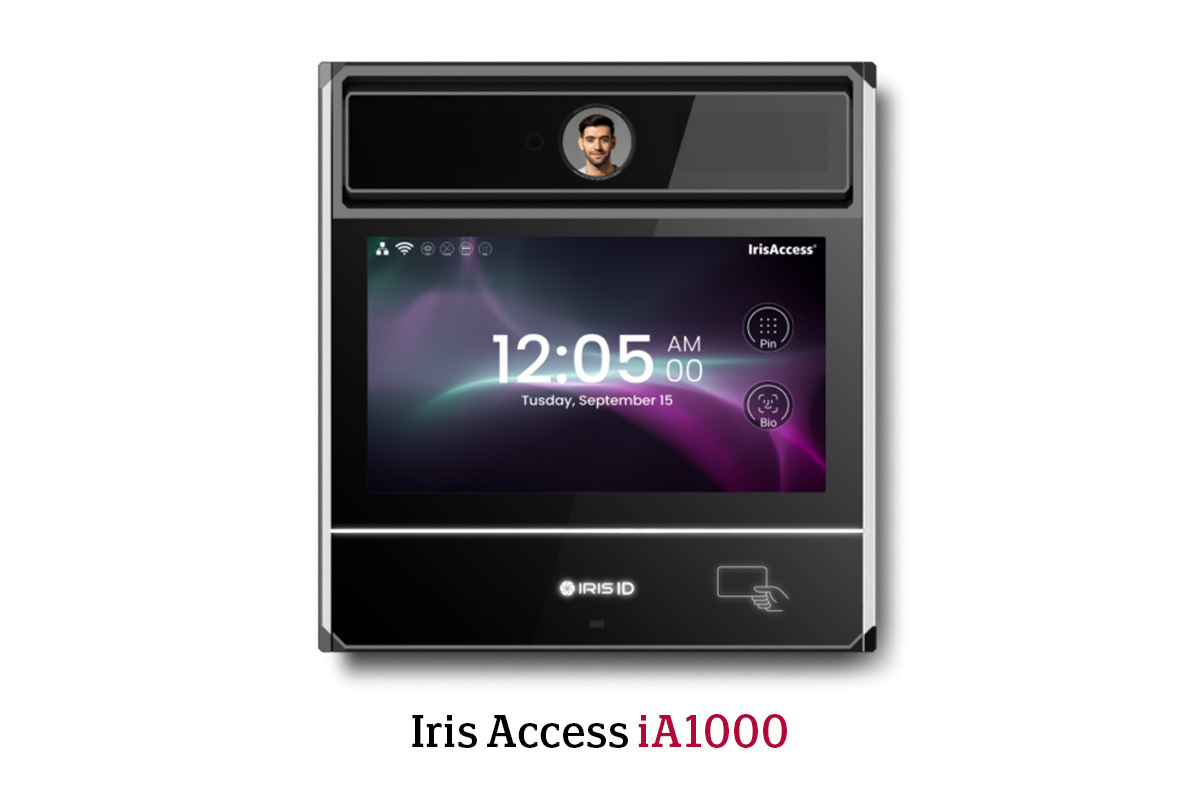
The IrisAccess iA1000 simultaneously captures both the user’s face and iris before making an access decision. Instead of asking: “Does this face appear to match?” Iris and Face Fusion asks: “Do both independent biometric identifiers verify this person’s identity?” That distinction dramatically increases confidence in every authentication event.
Benefits of multimodal fusion include:
- Higher authentication accuracy
- Lower false acceptance rates
- Reduced false rejections
- Greater confidence for security teams
- Stronger identity verification
- Improved user experience
Simply put – one biometric provides authentication, but two biometrics provide confidence. Iris and face authentication together deliver the precision access control that organizations need to reduce risk and ensure security.
Multi-Modal Iris and Face: Better Protection Against Spoofing
Modern attackers are increasingly using AI-generated images, high-resolution photographs, videos, masks, and synthetic media to bypass facial authentication systems. While face recognition vendors continue improving liveness detection, sophisticated presentation attacks remain a growing and evolving concern.
Iris ID’s fusion technology incorporates advanced Presentation Attack Defense (PAD) technologies that use AI and machine learning to identify fraudulent authentication attempts. These protections help defend against printed photographs, video replay attacks, 3D masks, cosmetic contact lenses, AI-generated biometric attacks and deepfake presentation attempts.
As biometric threats continue evolving, multimodal authentication offers much stronger security and accuracy.
Continuous Improvement with AI-Powered Authentication
Rather than relying solely on traditional image matching, AI and machine learning have allowed industry leaders to optimize the entire authentication process.
These technologies enhance image capture quality, user positioning, illumination adjustment, feature extraction, template generation, and more to ensure accuracy. The result is faster authentication, higher accuracy, and a better user experience.
Multimodal Authentication: Built for Enterprise Access Control
Many organizations require far more than convenient building access. They need trusted identity verification that integrates with existing enterprise security systems.
Token-based credentials – like cards, PINs, or mobile apps – can be shared, borrowed, or stolen. What businesses need is a biometric authentication system verifies the actual person requesting access. Multimodal iris & face authentication, like offered with the iA1000, is a perfect fit for this environment – helping to eliminate credential-sharing risks while strengthening access control.
Together, these capabilities enable organizations to improve identity assurance, reduce credential-sharing risks, strengthen protection against presentation attacks, and simplify deployment within existing access control environments.
Where Does Iris Face Fusion Deliver Maximum Value?
All organizations that are charged with protecting sensitive assets and data will realize the highest value from iris/face multimodal authentication.
Data Centers: Authenticate access to secure server rooms, tenant cages, command centers and other restricted facilities with greater confidence than face-only authentication solutions.
Government & Defense: Protect sensitive government facilities where rogue entry must be stopped and stolen, borrowed, or spoofed credentials carry serious risk.
SCIFs (Sensitive Compartmented Information Facilities): Support secure mantraps and classified environments with stronger identity verification.
Laboratories & Life Sciences: Enable touchless identity verification at pharmaceutical manufacturing facilities, cleanrooms, research laboratories, and biosafety labs.
Utilities & Critical Infrastructure: Authenticate personnel at substations, transit facilities, control rooms, and operational centers where positive ID is critical.
Why Access Control Buyers Should Go Beyond Convenience
Face recognition can be convenient, but when securing critical people, information and infrastructure, organizations should consider if appearance alone offers enough confidence in someone’s true identity.
The price gap between authentication technologies pales in comparison to the cost of a successful attack.
That’s why at organizations where security is paramount, multimodal iris and facial recognition biometrics are providing better protection, greater confidence, and a stronger security posture.
Combining one of the world’s most accurate biometrics with cutting-edge facial recognition, AI-powered presentation attack detection and integrations designed for the modern enterprise, Iris ID Fusion technology empowers organizations to think beyond recognition and embrace trusted – and verifiable – identity.
Frequently Asked Questions (FAQs)
- Is iris recognition more accurate than face recognition?
Yes. Iris recognition is generally considered to be one of the most accurate biometric authentication methods (99.98% accuracy), as the patterns in irises are unique, do not change over a person’s lifetime, and are difficult to replicate.
- What is multimodal biometric authentication?
Multimodal biometric authentication verifies a user’s identity using two or more biometric characteristics, such as iris recognition and facial recognition, rather than relying on a single biometric trait. By combining multiple independent identifiers, organizations can improve authentication accuracy, reduce false acceptance rates, strengthen protection against spoofing attacks, and provide more trusted identity verification for enterprise access control and critical infrastructure.
- Why combine iris and face recognition?
Combining iris recognition and facial recognition creates a multimodal biometric authentication solution that verifies two independent biometric identifiers during a single authentication event. This provides higher identity assurance, reduces false matches, strengthens resistance to presentation attacks and spoofing attempts, and gives security teams greater confidence when protecting data centers, government facilities, airports, laboratories and other high-security environments.
- Can Iris ID Fusion prevent spoofing attacks?
Iris ID’s iris and face fusion incorporates AI-powered Presentation Attack Detection (PAD) technologies designed to identify photographs, video replay attacks, masks, cosmetic contact lenses, and other presentation attacks before access is granted. By combining advanced PAD with simultaneous iris and facial recognition, it provides multiple layers of defense against increasingly sophisticated spoofing and deepfake attacks.
- Which industries benefit most from multimodal iris and face recognition technology?
Industries that benefit most from multimodal iris and face recognition technology are those that require higher identity assurance and stronger protection against spoofing attacks than what face-only authentication can provide. These include data centers, government and defense, SCIFs, airports, laboratories, life sciences, utilities, financial institutions, and other critical infrastructure facilities. By combining iris and facial recognition into a single authentication event, organizations gain more trusted identity verification for high-security access control.
- Does Iris ID Fusion integrate with existing access control systems?
Yes. Iris ID’s IrisAccess iA1000 supports enterprise integrations through OSDP, Wiegand, REST APIs, centralized iAMS management, and card/PIN authentication, making it compatible with many existing access control environments.